
Conservation Ethic
Conservation Ethic
What has the Eagle Rock Ranch voluntarily done to enhance and conserve natural resources?
“Every ranch has at least one, usually more!” The announcement came swiftly and confidently from the seller sitting in his saddle overlooking the junk strewn before us. The realtor nodded up and down in agreement. Collectively, it was presented as fact. No indication of any shame or embarrassment. No brooking for dissent tolerated. Sadly, based on our albeit limited experience, we reluctantly had to agree. By this time, we had seen it on each of the properties we had visited.¹
We – on the other hand – as prospective purchasers looked on in dismay at the trash dump spread out before us. “No,” we each thought to ourselves equally as confidently, “this will not stand - not on OUR watch!” Shaking our heads, we continued our horseback tour of the ranch. And yes, in the words of Wallace Stegner, so began the task. We imagined what it once was, dreamt of what it yet might be, swallowed hard and went ahead, closed on the property – this was many years ago now – rolled up our sleeves, and went to work. The land needed us. So did the river. And the wildlife. We in turn needed all of them. A brighter future beckoned for us all. Our covenant of reciprocity was joined at that moment.
Years of toil, excavation and removal soon followed, cycling through the seasons, and filling up and sending off a seemingly never-ending series of jumbo-sized roll-offs, trips to the recycling centers – one such garbage dump (and yes, there was more than one) produced over 80 cast-off tires of one sort or another. The river produced a similar bounty of discarded tires, t-posts, car parts, trash and fencing wire.
A gentle but undeniably consistent drainage – indeed an intermittent creek fed by a spring - ran through the creaky ancient cattle pens at the headquarters ensuring a constant living environment of mud, manure, and mosquitos interrupted only in the winter by sub-zero temperatures that froze everything into place. Fresh water was an issue – being delivered by long hoses that froze in winter. Neighbors would come by and tell us of the constant knee-deep mud endured by horses and cattle alike that were forced to live in such conditions. It all drained out into open fields and ultimately the river. An open sore on the landscape. A gaping wound.
Fencing had been torn apart by migrating elk, and multi-bang propane-powered wildlife cannons had been strategically positioned throughout to ward off any wayward wildlife and birds that might otherwise find their way onto the property. There was a running feud underway between the previous owner and the Colorado Parks & Wildlife (“CPW”) personnel that operated a State Wildlife area on two sides of the ranch, as well as with the USFS personnel that managed lands on the other two sides. Lots of fence-mending work to do – both literally and figuratively.
Hay fields were mowed to the ground and from fence line to fence line. Any willow that dared show its presence along the river was promptly cut to make room for additional hay. There was even a long-neglected homestead cabin on the property that was filled with manure and had been used as a chicken coop!
Again, we looked on and figured there had to be a better way. For us, our employee, for the livestock, and ultimately for the land. Planning began in terms of not only establishing an orderly spatial structure within the ranch, but also a workable temporal structure as well – one that better aligned with nature and what surrounded us.
That was then. This is now. The trash dumps and burn pits are gone, all of them, the accumulated garbage of a ranch over 150 years old has been removed² and the land restored and replanted with a variety of native grasses. The old broken-down and rotted wooden corrals have been removed, creosote posts removed, with a retention and settling pond established high above the working pens. An underground culvert system has now been installed that captures any runoff overflow from the pond and takes it safely and cleanly underneath, bypassing the newly-reconstructed pens and safely out into the hay fields, completely free of any contamination from the livestock pens. Without the constant influx of water, the pens are now dry and clean. The old homestead cabins have been fully cleaned and professionally restored. In connection with the drying up of the area, and the introduction of bats and barn swallows – our mosquito population has been significantly reduced. Livestock health has improved along with safety and the environment. New water lines have been installed at eight-foot depth, well below frost levels and fresh water is now available year-round. The new pens are constructed of recycled structural iron pipe, are now safe for humans and livestock alike, and will endure for many years.
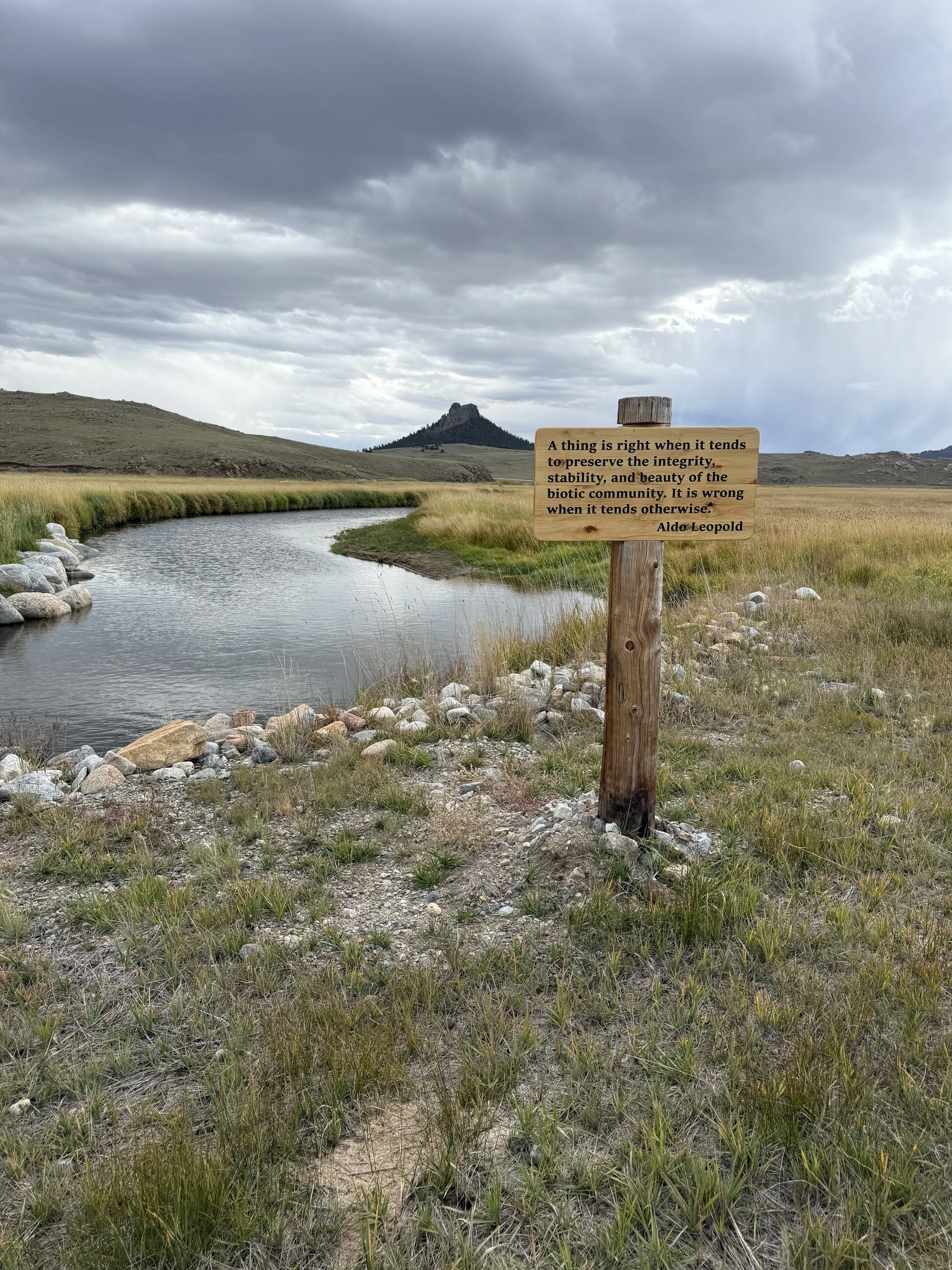
The river now runs clean and free of manure and trash. It sparkles and winks in the sunlight. Fish flash their silvery sides and tails. Over 250 stream improvements in the form of erosion control and fishing habitat structures have been put into place. Over a thousand new willow saplings have been planted in critical areas along the river, improving natural erosion control and providing shade for trout.³ The beavers have returned. Long-neglected ditches and diversion structures have been cleaned and improved. Ditch screens have been installed to keep fish from entering our irrigation ditches and fish ladders have been installed to ensure that trout can have access to the entire section of river for spawning.⁴ We are now an integral part of an Orvis-endorsed fishing operation. Wildlife-friendly fencing has replaced the creaky old barbed wire fences that were once the rule. Ranch tours are now given with pride and devoid of excuses.
Miles of recently-installed underground pipe in our pastures now carry fresh drinking water to 10 cattle/wildlife tire-drinkers sourced from a solar pump high on a hillside – all solar powered and gravity fed. Grazing cattle are thus spread out across the fields, increasing their available forage while decreasing their cumulative impact on the land. Each and every drinker has a “critter ramp” installed to allow wayward birds and other critters to escape safely should they unwittingly fall into the tank.
Almost 40 bird houses have been built on-site, designed and installed specifically to attract the return of the Mountain Bluebird along with bat houses (for pollination and mosquito control), and owl boxes (for rodent control. Cliff and barn swallows compete for mosquitos.⁵
We leave a long stubble on our hay fields when cutting as well as a sizable border margin along the river to promote insect habitat, fishery quality, water quality, weed control, and to slow the movement of water across the land in order to increase soil moisture and prevent soil erosion. This expanse of sward serves to provide wildlife habitat, particularly certain avian, rodent and microtine populations (all voracious eaters of weed seed) and to capture snow in the winter improving moisture content in the soil and facilitating earlier “green-up” in the spring. No artificial chemical fertilizers are used nor are any herbicides. Consulting with researchers at the Denver Zoo Conservation Alliance, we’ve identified and facilitated the development of dung beetles in our soil. We’ve eliminated the use of pesticides and insecticides on our cattle thereby improving dung beetle habitat as well as the overall health of our soil. Remote sensors monitor soil moisture levels. As a result, the ranch is a CDA-certified, weed-free hay operation producing quality, ultra-premium grass hay.
Perhaps unique to the Eagle Rock Ranch, in 2023 we partnered with the Colorado Natural Heritage Program (“CNHP”) to survey the biological resources of the Ranch for the purposes of establishing a baseline biotic survey against which future efforts could be measured and compared. The Survey indicates, inter alia, that:
“Eagle Rock Ranch lies in a mostly unfragmented landscape of natural lands, and the open lands of the ranch provide an important corridor for animal and vegetation dispersal. A diversity of habitats, including wetlands, grasslands, and rock outcrops, support a high degree of biodiversity and harbors high quality plant species and five vascular plant species of conservation concerns. Four of these plant species are regional endemics, considered to be globally and state vulnerable . . .. Riparian, irrigated, and ground-water fed wetlands on the Ranch support significant wildlife and ecological functions in the arid environment of South Park. Aquatic insects in Tarryall Creek within the ranch from the Ephemeroptera and Trichoptera orders are a testament to the ecological quality of the landscape and the creek’s water quality within the ranch. A diverse assemblage of birds and the largely intact bird community are a further indication of good ecological integrity found at the ranch . . .. Current grazing practices have resulted in a landscape that is in a natural state, supporting an abundance and diversity of wildlife and significant vegetation, including populations of Colorado Tansy-aster [considered to be globally and state vulnerable] and upland grassland habitats of excellent condition. An important consideration for the ranch is to promote management activities supporting movement corridors for the ungulate community . . .. The conservation value of the natural vegetation and wildlife habitat preserved by this working ranch cannot be overstated.” [emphasis added].
1 Wounds, unseen by most, and “quite invisible to laymen,” but nevertheless are “the marks of death in a community that believes itself well, and does not want to be told otherwise.” Aldo Leopold, 1947 Foreword to Great Possessions, J. Baird Callicott, Companion to A Sand County Almanac, 286. See also “An Enemy of the People,” by Henrik Ibsen.
2 For the first time in its history, the ranch now has regularly-scheduled trash service.
3 À la Aldo Leopold with respect to his beloved pines, and also Elzéard Bouffier, in Jean Giono’s classic “The Man Who Planted Trees” - first published in 1954, in Vogue magazine, under the title, “The Man Who Planted Hope and Grew Happiness.”
4 Our Water Commissioner says that we are the only ranch in his district (upper South Platte headwaters area) that has installed ditch screens or fish ladders in their irrigation and diversion systems.
5 See previously unpublished essay by Aldo Leopold, “Bluebirds Welcome,” in J. Baird Callicott and E. T. Freyfogle, “For the Health of the Land: Previously Unpublished Essays and Other Writings (1999), p. 112.
6 The hay so produced won the Blue Ribbon and Best of Show at the Colorado State Fair in 2024.
7 The resulting 150-page report, entitled “Biological Survey of Eagle Rock Ranch, Park County, Colorado” is available for public inspection and review on the CNHP website, i.e.,
https://cnhp.colostate.edu/download/documents/2023/CNHP-Eagle-Rock-Ranch-Biodiversity-Survey-Report_20240310_Combined.pdf