
Ecological Community
Ecological Community
How does the agricultural operation at the Eagle Rock Ranch work with natural systems (soil, water, plants and wildlife, etc.). Does any of this benefit others?
In the last few pages of his SCA capstone essay, The Land Ethic, Aldo Leopold called for landowners to live in ways that sustain land health. Going further, he charged landowners affirmatively with “responsibility for the health of the land.”¹ The health he championed was the welfare of the biotic community as such, the community of which humans are also a part. Humans thus benefit from this ethic indirectly, by virtue of their participation in the land community, and the gains they derive from its long-term health. In his last decade of life, he increasingly saw the aspect of private responsibility for land health as perhaps the key component for his concept of conservation. Lecturing to students, he declared, that in “viewing the field as a whole, we see one common denominator: regard for community welfare is the keystone to conservation.”² He continued, “private land is only a stock certificate in a common biota. Private land-use must recognize an obligation to community welfare.”³
He adds in the same essay that “conservation is a state of harmony between men and land.”⁴ What then is “harmony” and how do you know when you’ve found it? Can it be measured?
The essay leaves no blueprint on exactly what is “harmony” although Professor Leopold goes on to emphasize (again, strongly) the affirmative obligations of private landowners and that a land ethic requires the development of an ecological conscience – that leads us to recognize land as “something we can see, feel, understand, love, or otherwise have faith in.”⁵
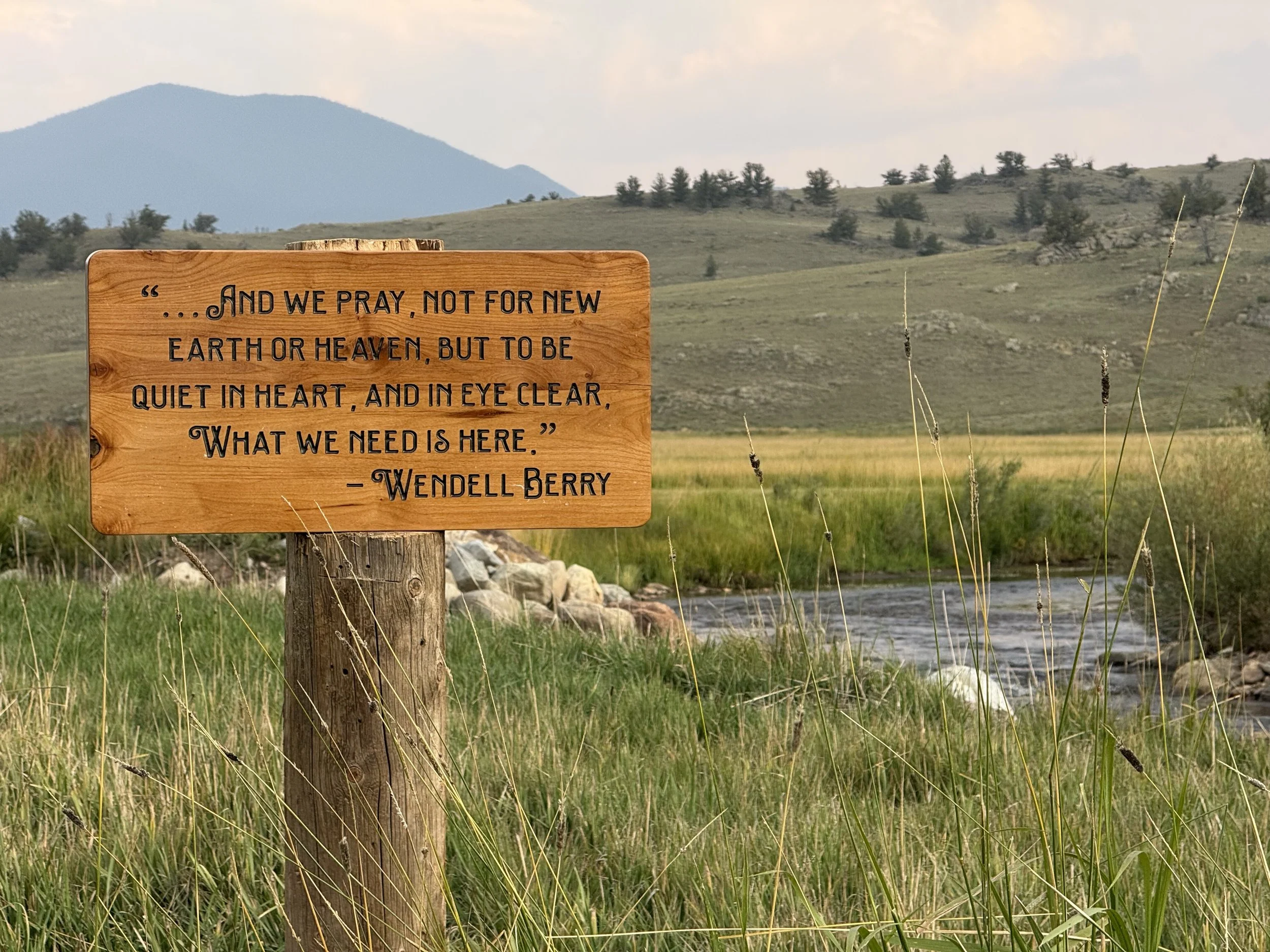
Later writers have given this concept of harmony a bit more ink. For example, Professor Robin Wall Kimmerer discusses ecological harmony as a series of “reciprocities” between and amongst the inhabitants thereof – millions of them – some voluntary, some not so much.⁶ Wendell Berry posits that harmony can be reached similarly through his concept of “mutualities.”⁷
We believe there is little daylight between them on this issue. Robin Kimmerer and Wendell Berry would have us shift from a consumer mindset to one of reciprocity or mutuality, seeing nature as an intertwined community of relatives, and adopting attitudes of gratitude, humility, listening, perception, restoration, and stewardship.
Wes Jackson postulates that we measure our progress in this regard by envisioning what the landscape looked like, consisted of, etc. before we arrived – i.e., “measuring by nature.”⁸
At the Eagle Rock Ranch then, how do we discharge this responsibility for land health? What do we do in the way of reciprocities or mutualities that help us achieve harmony and give us a pathway to citizenship in this biotic community? First, we take our “measure” per Wes Jackson and envision what the land here looked like several hundred years ago, indeed thousands or even millions of years ago, etc. Geology⁹ and geomorphology¹⁰ provide some clues. Ancient tepee rings found on ranch property, and the associated presence of indigenous artifacts – some dating back over 10,000 years - give us a sense of who else might have lived here, and when. The soil build-up around the abandoned stones surrounding the tepee ring give us a feel for the rate of soil formation over the intervening years. Water-polished rocks and boulders found at some depth in our hay meadows give us an idea of where the river formerly ran together with the velocity during some flooding episodes, etc. Some bristlecone pines in the area are over 2,100 years old. A study of various undisturbed parcels up and down the valley gives us a sense of what vegetation might have been present.
So we’ve taken our measure and have adopted the reciprocity values advocated by Professor Kimmerer and Wendell Berry to get closer to the harmony articulated by Aldo Leopold. Taken in totality, and as discussed above, we’ve taken a “whole systems” approach.
Specifically, and as discussed above, we leave our hay stubble long for a variety of reasons – for habitat as well as soil and water quality. Little acts of reciprocity – but lots of them. We help them, they help us.
The ranch refrains from the use of chemicals on our landscape as well as on our livestock helping soil, water and livestock alike – likewise all as discussed above.
We install bat boxes, owl boxes, and offer refuge to swallows, hummingbirds and other birds to provide homes for pollinators, insect eaters, weed seed eaters, and rodent control. Haying operations are deferred until after mid-summer to allow ground-nesting birds to hatch their broods. We drop fences and leave gates open thru the winter and don’t put them back until late spring/early summer to allow deer and elk to both migrate through and also calve in peace on our hay meadows and in our fields. We restrict our access to these areas during this time. More mutualities that provide reciprocal benefits to the other citizens here in this natural system.
We’ve put in over 250 erosion control and fish habitat structures in and around our river to promote fish habitat. Our ditch screens and fish ladders assist in keeping fish out of our irrigation ditches and enable them to gain access to the entire river for spawning purposes. Artificial fish stocking with non-native species is discouraged, thus allowing a native, wild trout population to flourish. Our angler visitors enjoy catching the “wild fish” that inhabit our section of river. They tell us that is more challenging than catching the farm-fed fat ones in other parts of the river.
Cattle are thoughtfully rotated through various pastures to put down manure for natural fertilizer and the spreading of seed, but also to ensure protection of endangered plant species and protection of grass cover. In lieu of motorized ATV’s, we use horses when moving or gathering cattle to keep stress low on the cattle but also to avoid soil damage and the creation of tire ruts. It keeps things quieter as well. Cattle drinkers have been installed on adjacent slopes and away from riparian areas to encourage good cattle movement and evenly-spaced grazing of forage. More reciprocities.
Breeding of our mother cows is timed so that calving occurs in the time frame used by other native ungulates in the ecosystem, such as elk, deer and antelope. Listening to what the native animals are telling us. Professor Leopold would approve, I think.
Are we there yet? Have we achieved “harmony?” Are we perfect? Absolutely not, but we’re working on it and making progress. It remains, in the words of Wallace Stegner, “a task.” And as Aldo Leopold once said, “[w]e shall never achieve harmony with land, any more than we shall achieve absolute justice or liberty for people. In these higher aspirations the important thing is not to achieve but to strive.”¹¹ So, we’re striving.
How does any of this benefit others? Our efforts to integrate our cattle and natural hay operation into the natural system not only benefit us and the biotic community around us, but also the public by protecting essential resources like clean water, our wetlands which filter water and release it through return flows later in the season, air quality, and food sources, preserving wildlife habitats, offering recreation opportunities, supporting local economies through the provision of employment and regenerative ranching, all of which happens in a more cost-effective manner than through a strictly publicly-managed system. The Eagle Rock Ranch is a partner in stewardship with the USFS and CPW, in providing public good from our property through methods like the innovative Elk Migration Agreement which keep working lands productive and natural spaces intact for wildlife and the public.
Additional benefits to the public include providing open space, view-scapes, keeping ranch land and working lands in production, supporting local food systems, local economies, and preventing subdivision and sprawl. The incredible biodiversity existing on the ranch (as verified by the CNHP report) safeguards habitat for rare and endangered species of both flora and fauna. Our direct-to-consumer beef sales benefit the public as well by providing a means by which urban dwellers can engage and support acts of reciprocity.¹²
Still more public benefits are provided in the form of climate resilience as a result of the carbon-storing ecosystem supported by the Ranch, which helps stabilize air quality and resultant weather patterns. The Ranch is located in the South Park National Heritage area, and within the Tarryall Road Rural Historic Landscape District, as well as the National Register of Historic Places and Colorado State Register of Historic Properties. When the National Park Service so designated the Ranch as part of these districts in 2017, it was noted that the Ranch “represents high-altitude ranching, early transportation corridors (wagon road to mining camps), agriculture, and recreation, preserving a blend of natural beauty and historic structures.” Further, the Ranch (and associated district) represents
“a large, cohesive, cultural landscape, not just individual buildings, showcasing how human activity shaped the environment over time. It tells the story of pioneer settlement, the gold rush era, and the development of ranching in South Park. The landscape is significant for its architectural resources and the archaeological evidence of early life.”
Our ranch tours also benefit the general public, virtually all of whom come from urban areas. We’ve had them in here individually and by the busload. Offered at a nominal cost, we try to re-establish some degree of connectiveness with the land and with nature. We try and get them to use all their tactile senses – we’ll go into a tack room with all the smells of leather and horse sweat – saddle up a horse or two – get them to hold a brush in their hands or carry a saddle, blanket or bridle. Touch a horse, a friendly cattle dog, a barn cat. A lot of people just never get to do these things any more. Stand at the bridge and look for trout in the water. Turn on or adjust a headgate – see water flow – take a Brix reading on hay – perhaps visit our laboratory and look at some lichen, moss or an insect thru a microscope – look thru the pressed plants in our very own herbarium. I’ll pick up or turn over a piece of cow manure and we’ll look for dung beetles. We’ll go out and look for rare species that we know are out there. Discussion ensues. It’s an entirely new experience. New friends are made. A bit of the rural-urban divide is bridged.
1 Leopold, A. 1949. A Sand County Almanac. Oxford University Press, New York, New York, at 221.
2 Leopold, A., “Motives for Conservation,” (undated lecture), Aldo Leopold Archives, at 9/25/10-6; Box 14, Folder 3, p. 434.
3 Id.
4 Leopold, A., A Sand County Almanac, supra note 1 at 207.
5 Leopold, A., A Sand County Almanac, supra note 1 at 214. Professor Leopold describes a “cooperative” concept of harmony in a previous version of this essay, Conservation, published posthumously in Leopold, A. 1953. Round River. Oxford University Press, New York, New York, at pp. 145-146, “The land is one organism. Its parts, like our own parts, compete with each other and co-operate with each other. The competitions are as much a part of the inner workings as the co-operations.”
6 Kimmerer, R.W. 2013. Braiding Sweetgrass. Milkweed Editions. p. 190. “The Honorable Harvest asks us to give back, in reciprocity, for what we have been given. Reciprocity helps resolve the moral tension of taking a life by giving in return something of value that sustains the ones who sustain us. . . We can do it through gratitude, through ceremony, through land stewardship, science, art and in everyday acts of practical reverence.”
7 Berry, W. 2015. The Unsettling of America. Counterpoint Press. P. 91
8 Jackson, W. 2011. Nature as Measure. Counterpoint Press. Pp 68, 176, “Do not try to improve on this patch of native prairie, for it will serve as your standard by which to judge your agricultural practices. There is no higher standard of your performance than the land and its natural community.”
9 Some of the oldest rocks in Colorado are found on the ranch, having their genesis in seabed sedimentary rocks (originally soil!) subducted to a depth of over twelve miles below sea level, metamorphosed, intruded, faulted, and lifted to their present position of two miles above sea level. Quite a journey encompassing over 1.7 billion years. In time, these rocks will become soil once again and start another journey to the sea.
10 Our location was spared the glacial sculpturing that affected the northern portion of Park County during the Pleistocene Era so the majority of landscapes here was formed via water and wind erosion coupled with geologic faulting.
11 Leopold, A. 1953. Round River. Oxford University Press, New York, New York. p. 155
12 Professor Robin Wall Kimmerer writes, i.e., “[w]e could lament that urban dwellers have little means of exercising direct reciprocity with the land. Yet while city folks may be separated from the sources of what they consume, they can exercise reciprocity through how they spend their money . . .. “ See, Kimmerer, R.W., Braiding Sweetgrass, supra note 6, p. 195.