
The Upshot
The Upshot
What is the upshot of all this? Why the fuss over someone who died almost 80 years ago?
I first read Aldo Leopold’s A Sand County Almanac a long, long time ago – albeit as that time is measured by us short-lived humans (who possess even shorter memories). The “Deep Time” geologic standard as articulated by John McPhee in Basin and Range is yet another perspective worth consideration; by that measure our human concept of time is but trifling.¹ Nevertheless, by that reading – done in a biological field station in a Boundary Water setting and under the tutelage of a botany professor named Muir (yes, that Muir family) – I acquired an influence and an initial seed of perception that would take root and remain with me for my lifetime. At that time, my reading was done in conjunction with a field course I was enrolled in, that was then coupled with a backcountry canoe trip along a route taken by Aldo Leopold and his brother Carl then perhaps some forty years prior and outlined in a later collection of his essays entitled Round River. I’m still following Professor Leopold’s track many years later as I ride horseback and explore the Tres Piedras district in the Carson National Forest. We’re going back and will be staying a few nights in his beloved Mi Casita² this coming spring.
My experience with SCA has not been unique, however, and in the many years following my initial reading, there have been plenty of re-readings, reflection, contemplation and opportunity to contemplate just how this man achieved so much in his relatively short lifetime and the legacy he left. Certainly, he was a thoughtful, measured and considered man, educated in the natural and physical sciences, and gifted with an extraordinarily observant eye and curious mind. But I believe that there were two additional things that were essential to his development: (i) he was both a hunter and an angler – he had a deep and abiding personal relationship to wildlife; and (ii) he was a steward of working lands, more importantly, a first-generation land steward who arrived at his position with no history of personal or family land stewardship, only a blank slate together with the challenge, as he put it, to try and fulfill “the oldest task in human history: to live on a piece of land without spoiling it.”³
Years of following the man (both literally and figuratively), his writings and his ramblings have ensued, not at all even remotely resembling a straight line, but nevertheless inexorably leading my wife Jeannie and I, along with our family, to this high mountain ranch in central Colorado where we found a wounded landscape and are now attempting to restore and to dwell, in the Heidegger sense, and seeking citizenship in this biotic community.⁴ Fifty years of collecting memorabilia and assorted items along the way have resulted in a few “Leopold benches” being built and located here or given away, a collection of various editions of his books, and having the good fortune of acquiring a desk made by Aldo’s father around the turn of the last century where I sit and write this application. I envision young Aldo playing “go-fer” while his father built this desk and perhaps handling some of the wood pieces that comprise this heirloom piece at which I sit. It’s been quite a journey altogether and one that brings me a great deal of satisfaction.
We built a separate natural sciences laboratory on the ranch not far from our house together with a herbarium that houses our pressed plant and flower specimens, including the rare and endangered species identified in the CNHP Report. Our goal is to gather (and press) samples of all floral species on the ranch – and we’re well on our way. Other samples of our flora (mainly lichens) are stored in the University of Colorado Herbarium in Boulder. But our geologic rock samples, plant and insect samples etc. – along with our microscopes – are in our laboratory that can also be toured by our ranch visitors. But I digress.
The Upshot.
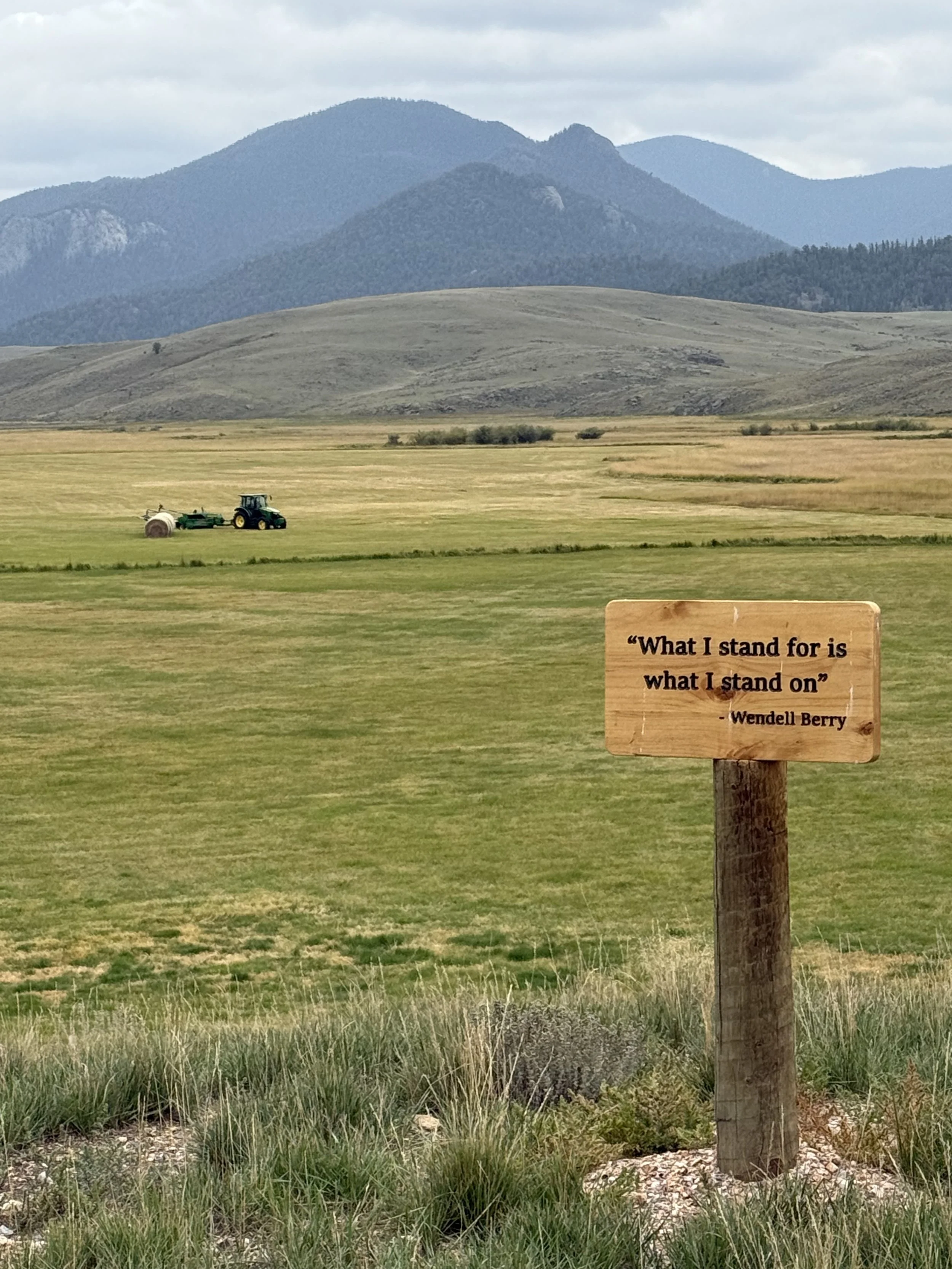
In sum, what we have contemplated and undertaken here at the Eagle Rock Ranch since we were first introduced to the trash dump is more than ecological restoration, it is the visualization and restoration of a reciprocative relationship that once existed between the soil, plants, wildlife, livestock, and the people who dwell here. For as we restore the land, we also restore ourselves and perhaps a bit of restorative culture as well. And in striving to do that, we might manage to become worthy citizens of this biotic community. No higher honor can be sought.
1 In A Sand County Almanac, Professor Leopold uses the concept of time to illustrate his observations and describes events in natural history that occur on geologic, evolutionary, as well as ecological time-scales, thus providing a counter-perspective to the short-sighted human timescale that most people are accustomed to.
2 Now fully renovated and available for rental thru the USFS.
3 From a lecture delivered by Professor Leopold entitled, “Engineering and Conservation,” delivered on April 11, 1938, at the Univ. of Wisconsin College of Engineering. See Susan L. Fladler and J. Baird Callicott, eds., The River of the Mother of God and Other Essays by Aldo Leopold (Madison: Univ of Wisc. Press, 1991), 254.
4 In his first book, the largely technical Game Management (1933), Aldo Leopold had concluded that: “. . . twenty centuries of progress have brought the average citizen a vote, a national anthem, a Ford, a bank account, and a high opinion of himself, but not the capacity to live in high density without befouling and denuding his environment . . ..”