
Leadership in Conservation
Has the Eagle Rock Ranch or its owners made any efforts to share its conservation ethics and techniques with others inside and outside of agriculture? Why or why not? And if so, how?
We believe a defining characteristic of Aldo Leopold – and one we share – is his call for action, not just talk.¹ If we don’t talk about conservation, if we don’t educate people, then what good does it do to hold these beliefs? And if we don’t act upon it – what good is simply talking about it?²
Aldo Leopold devoted his professional life to not just “talking the talk, but walking the walk.” Community service and leadership were integral. He was a founder of the Wilderness Society (1935), director of the Audubon Society, a member of Franklin D. Roosevelt’s Special Committee on Wild Life Restoration, and designed and ran the first Game Management Department at a major university. He promoted democratic deliberation throughout and showed trust in citizens' ability to act upon what they saw, learned, and enjoyed. The key element is for private landowners to take action, and he saw economic and social incentives as a primary motivator, and cultural and aesthetic rewards as a result. We’ve taken this to heart.
As a member³ of the Colorado Parks & Wildlife (“CPW”) statewide Habitat Stamp Committee,⁴ Dave has urged the Committee to consider a myriad of mechanisms to achieve wildlife conservation goals, such as covenants, servitudes, term easements, etc. After receiving positive feedback, he initiated discussions with several land trust organizations and private conservation groups, ultimately working with the Colorado Cattlemen’s Agricultural Land Trust (“CCALT”) and the Property and Environment Research Center in Bozeman, MT (“PERC”) to develop the nation’s first “Elk Migration Agreement” that proactively compensates landowners for allowing elk and other ungulate migration through their property. It is a voluntary, incentive-based, privately-funded concept that has since proved popular with cattle ranchers, landowners and managers across the western United States. Thanks to media outreach spearheaded by the Ranch in partnership with PERC and CCALT, the agreement was covered by 12 news outlets, including The Colorado Sun, Rocky Mountain PBS, FOX Denver and ABC Denver.⁵ Following the media attention, we have fielded inquiries from private organizations, ranchers, land managers, etc., that are interested in this concept. Neighbors are also asking questions about wildlife-friendly fences and have started taking down high fences and leaving their gates open in winter to facilitate wildlife movement.
Other conservation efforts have also earned local and national media coverage, including reporting on our wildlife-friendly fencing in Modern Farmer and The Colorado Sun; the rehabilitation and successful release of a sick bald eagle found at the Ranch in The Denver Post and NBC Denver; and national coverage of the CNHP biotic survey in Forbes.⁶ For a full account of the media coverage received for these efforts (and others), please see the Press section of the ranch website – only one click away.⁷
As a member of the State Habitat Partnership Program (“HPP”) Council, I proposed a first-ever Conflict of Interest Policy (and Ethics Code) for the State Council as well as the numerous local HPP committees around the state, and then worked with the Director of the State HPP program and the Colorado Attorney General’s office on its development and passage. Another proposal of mine was to correlate the projects we evaluate with priorities developed by the 2024 CPW “Habitat Conservation and Connectivity Plan”⁸ and the 2020 Report on Big Game Winter Range and Migration Corridors. This proposal was also adopted by the State HPP Council.
We’ve begun research into elk and deer road crossings/vehicle accidents in collaboration with PERC, focused on the potential development of “low-tech” wildlife crossings on county roads and highways. We have installed wildlife-friendly fence crossings on our property adjacent to the county highway with trail cameras mounted to observe crossings on these sections and also on standard fence sections. We believe (and we’ll soon have data to support this) that elk can be “conditioned” to cross at certain fence sections (dependent on geography and wildlife-friendly design). Our next step will be to locate mobile electronic road signage warning of “Wildlife on Road,” triggered by motion cameras to prevent or reduce collisions.
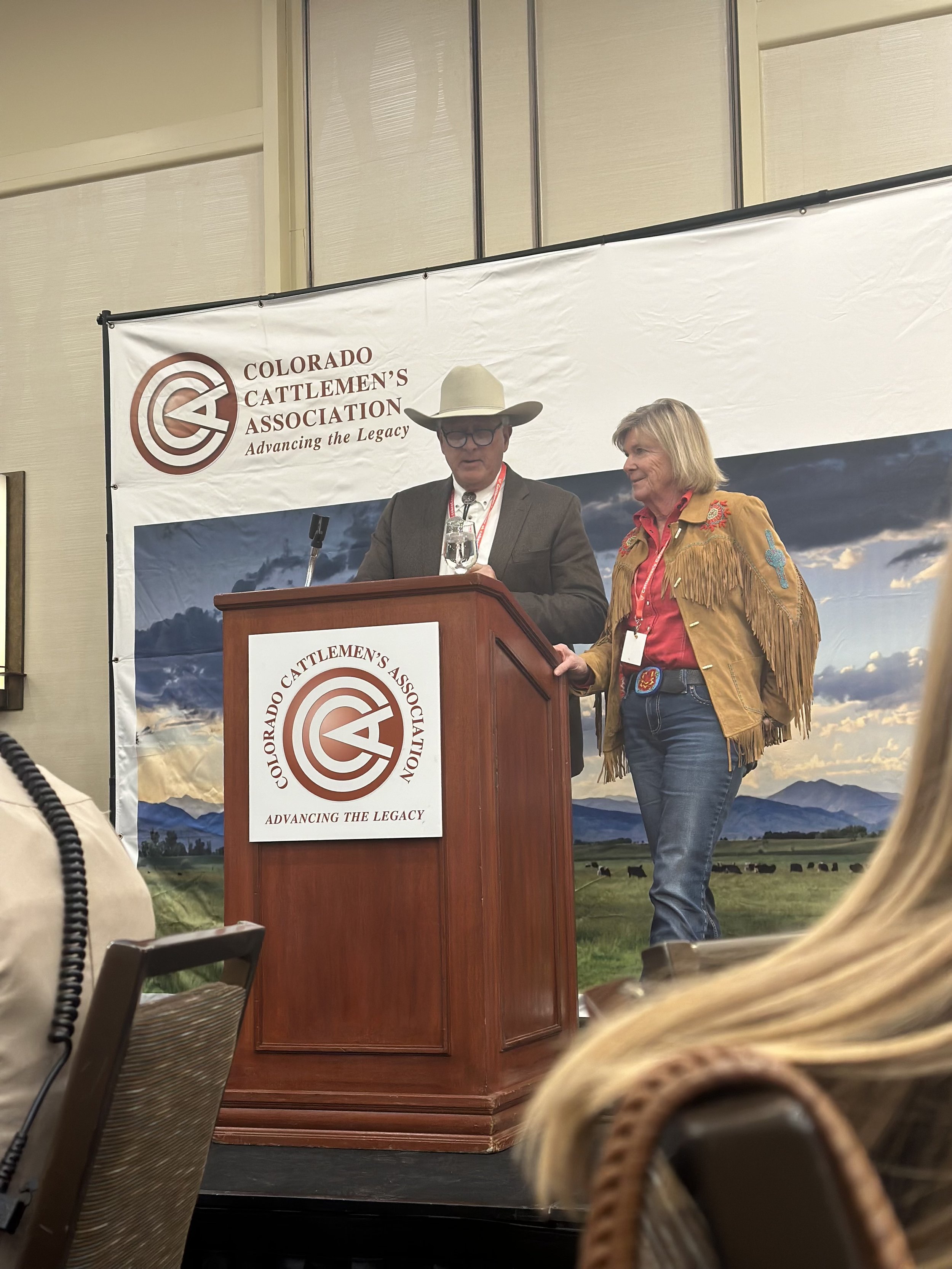
In recent years, Dave and Jean have been invited to speak with students and professors at the University of Colorado – Center for the American West, and also Colorado State University. Topics have ranged from wolf/livestock interactions to wildlife conservation on private working lands and ruminant grazing. We invariably distribute copies of “A Sand County Almanac” that we bring with us each visit, along with a friendly warning that “this book changed my life and it might change yours!”
Last year, Dave presented on wildlife conservation on private lands, including the Elk Migration Agreement, at the sold-out 2025 “Partners in the Outdoors” Conference sponsored by Colorado Parks and Wildlife. At the end of the presentation, he again distributed copies of “A Sand County Almanac” to all attendees.
Finally, the Ranch is well-represented on civic, state, and community organizations. Erin serves as a Director on the Colorado State Fair Authority Board,⁹ as a Director of the Colorado State Fair Foundation, and a newly appointed Director of the Colorado Cattlemen’s Agricultural Land Trust. In addition to Dave’s position as a Member and Vice Chair of the CPW State Habitat Stamp Committee, he is also a Member of the CPW State Habitat Partnership Program, the local South Park Habitat Partnership Program, the Colorado Department of Agriculture Soil Health Advisory Committee, a Trustee of the Teller-Park Soil Conservation District, past President of the Central Colorado Cattlemen’s Association, a Director of the Roundup Riders of the Rockies and Chair of its Ride & Trail Committee, a member of the Western Landowner’s Alliance, a member of the Colorado Department of Agriculture S.T.A.R. (Saving Tomorrow's Agricultural Resources) Program, and a member of the Colorado Cattlemen’s Association, serving on committees including Property Rights & Resource Stewardship, Wildlife Resources, Federal Lands, and Animal Health & Welfare. We also are BQA (Beef Quality Assurance) certified members.
1 “We tilt windmills in behalf of conservation in convention halls and editorial offices, but on the back forty we disclaim even owning a lance.” SCA, 158. See also, “What we hear of conservation is mostly what transpires in the parlor of land use. This is a factual account of what happens in the kitchen.” – Aldo Leopold, 1941, Shack Journal Entry, as recounted in Sherman Paul, “For Love of the World,” p. 45.
2 “Despite nearly a century of propaganda, conservation still proceeds at a snail’s pace; progress still consists of largely letterhead pieties and convention oratory. On the back forty we still slip two steps backward for each forward stride.” SCA, 207.
3 A position nominated by the Governor, and reviewed and confirmed by the Senate – Dave’s nomination was approved unanimously by a bi-partisan Senate committee, and approved unanimously by the Colorado Senate. Dave is in his second term, and currently serves as Vice-Chair of this Committee.
4 The Committee’s goal is to identify projects that protect big game winter range and migration corridors, acquiring public access for hunting, fishing and wildlife viewing, protecting habitat for rare and endangered species as well as species of concern, and preserving the diversity of wildlife enjoyed by all Coloradans. In its relatively short history, the Colorado Wildlife Habitat Program has secured – in perpetuity – over 300,000 acres of conservation easements, 156,000 acres of public access easement, 35,000 acres of fee title (to be converted into new State Wildlife Areas), and over 400 miles of river access for Colorado anglers.
5 See also, “Elk win the right of way in Colorado thanks to a rancher’s bold conservation deal,” https://www.optimistdaily.com/2025/12/elk-win-the-right-of-way-in-colorado-thanks-to-a-ranchers-bold-conservation-deal-2/; https://kdvr.com/news/local/cattle-rancher-being-compensated-for-damage-caused-by-elk/; https://www.denver7.com/news/local-news/how-colorados-first-elk-migration-agreement-marks-a-big-step-for-conservation-and-agricultural-productivity; see also, e.g., “Elk can migrate through private Colorado ranch after first-of-its-kind deal with conservation group,” https://coloradosun.com/2025/04/03/colorado-elk-migration-eagle-rock-ranch-conservation-agreement/; “Elk migration eased by South Park conservation effort,” Denver Gazette; https://www.theflume.com/news/eagle-rock-signs-colorados-first-elk-migration-agreement/article_2fb7faec-f9e6-11ef-8a47-eba8ae7af52b.html; and “A Ranch Older than Colorado is Forging New Paths in Ecological Ranching,” https://www.rmpbs.org/blogs/science-environment/eagle-rock-ranch-elk-colorado.
6 See, “A Ranch Where Quality Beef Production And Biodiversity Coexist,” https://www.forbes.com/sites/stevensavage/2024/05/16/a-ranch-where-quality-beef-production-and-biodiversity-coexist/?sh=78d67e04677b
7 https://www.eaglerockbeef.com/press-page
8 CPW's Habitat Conservation and Connectivity Plan (HCCP) is a strategic framework to protect Colorado's wildlife habitats, focusing on securing large landscapes, big game corridors, riparian areas, and connectivity for species of concern, leveraging funding from habitat stamps and licenses for easements and acquisitions, aiming to balance development with conservation for recreation and biodiversity. The plan guides resource allocation, works with partners, and supports initiatives like wildlife crossings, ensuring resilient ecosystems despite climate change and development pressures, and integrating with broader state plans.
9 Nominated by the Governor, approved and unanimously confirmed by the Colorado State Senate.